Sizing
What Size Dumpster Do I Need? An Honest Westfield Guide
Most sizing guides lead with cubic yards. That is the least useful number, because almost nobody can estimate their own debris in cubic yards. Here is how we actually do it on the phone.
Why cubic yards is the wrong question
Every dumpster sizing guide opens the same way: a 10 yard holds ten cubic yards, a 20 yard holds twenty. True, and almost completely useless, because nobody standing in their cellar looking at forty years of accumulated stuff can convert that into cubic yards.
What we actually ask on the phone is three questions. What are you throwing away? How much of it, in terms you can picture — pickup loads, rooms, squares of roof? And where is it going to sit? Those three answers get us to the right container about ninety-five percent of the time, and everything after that is about weight.
The two constraints: volume and weight
Every container has two limits and you will hit one of them first. Volume is the obvious one: the box is only so big and you cannot legally load above the top rail. Weight is the one people forget, and it is the one that costs money.
Each size comes with an included tonnage. A 10 yard typically includes one to two tons, a 30 yard four to five. Go over and you pay a per-ton overage rate, which we quote before you book.
What each size really holds
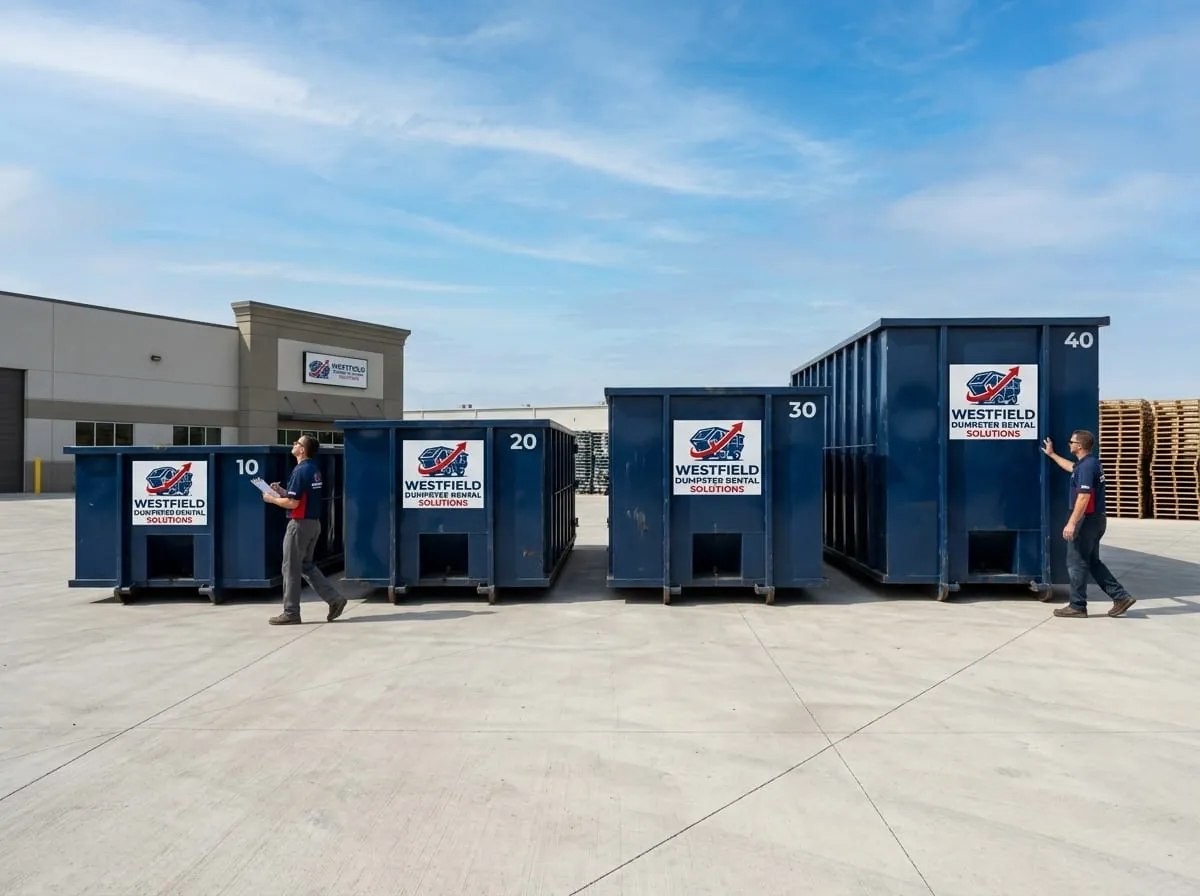
10 yard — 12 ft × 8 ft × 3.5 ft
Three to four pickup loads. One to two tons included. The small-job container and, more importantly, the heavy material container. A bathroom gut. A walkway slab. Broken concrete, brick and plaster. Low three-and-a-half-foot sides mean you can throw material over the wall without a ramp.
15 yard — 16 ft × 8 ft × 4 ft
Five to six pickup loads. Two to three tons. The most under-used size in the industry and the one we place most often across the older cities. Holyoke, Springfield, Chicopee and the hilltown villages were built on short single-width drives, and a 15 yard is sixteen feet against a 20 yard's twenty-two.
20 yard — 22 ft × 8 ft × 4.5 ft
Seven to eight pickup loads. Three to four tons. The standard container across Westfield's own neighbourhoods, Southwick, Agawam and Southampton, where driveways are generous.
30 yard — 22 ft × 8 ft × 6 ft
Ten to twelve pickup loads. Four to five tons. Same footprint as the 20 with eighteen more inches of height, so it holds half again as much without needing any more driveway. The builder's container, and the right call for a barn coming down out toward Granville, Blandford or Westhampton.
Worked examples from real valley jobs
| Job | Size | Why |
|---|---|---|
| Bathroom gut, plaster and tile | 10 yard | Small volume, but plaster and cast iron are heavy |
| Walkway or patio slab removal | 10 yard | Concrete is roughly 2 tons per cubic yard |
| Stone wall or old foundation | 10 yard | Fieldstone is the densest thing we haul |
| Two-car garage clear-out | 10-15 yard | Bulky, light, easy to load |
| Older city lot, short drive | 15 yard | Length is the limit, not volume |
| Kitchen renovation, mid-size | 15-20 yard | Cabinetry eats volume; a tile floor pushes weight up |
| Finished basement strip-out | 20 yard | Panelling, carpet and framing: big volume, low weight |
| Shingle re-roof, 26 squares | 20 yard | Around 4 tons of shingle - at the allowance limit |
| Three-bed whole-house clear-out | 20 yard | Furniture eats volume fast - mattresses excepted |
| Barn or outbuilding demolition | 30 yard | Timber and metal roofing: huge volume, low weight |
The weight traps in New England housing
Plaster and lath
The big one. Pre-1950 housing across Westfield, Holyoke, Springfield, Chicopee and the hilltown villages is plaster on wood lath, not drywall, and plaster is dramatically heavier. A room that would be a comfortable half-container of drywall is at its weight allowance in plaster.
Old-growth framing and fieldstone
The genuinely old property out in the hilltowns is oak and chestnut framing on fieldstone foundations. Both are far denser than anything milled or poured today.
Mill-building material
Particular to this region. Conversions and clearances in the old mill stock at Holyoke, Easthampton, Chicopee and Ludlow produce timber beams, masonry and cast iron in quantities that will fill a weight allowance startlingly fast.
Anything from a cellar that has been wet
Full cellars are standard here and river-valley property floods. Saturated carpet, panelling, drywall and framing weigh a multiple of their dry equivalent. Say so when you book.
Snow in an open container
A western Massachusetts winter puts real weight into an open container, and once it compacts and refreezes you pay to haul it. Keep it covered. More on winter here.
Valley or hilltown changes the answer
Westfield sits at a genuine hinge, and which side of it you are on changes the practical answer more than the debris does.
Down in the valley — Westfield's own neighbourhoods, Southwick, Agawam, West Springfield, Southampton — the ground is flat, driveways are generous and access is rarely the constraint. The debris decides the container.
Up in the hilltowns — Russell, Montgomery, Blandford, Granville, Chester, Huntington, Westhampton — it is long private drives on real grades, often unpaved, frequently wooded. There the drive decides the container, and the season decides the drive.
In the older cities — Holyoke, Springfield, Chicopee, downtown Northampton — it is short or absent driveways, on-street parking and mature street trees. A 15 yard is often the largest thing that will physically go in.
So when we ask where you are before we ask what you are throwing out, that is why.
Mattresses come out before anything else
Worth stating early because it affects sizing and it is not optional.
Practically, that means a whole-house clear-out gets counted twice: the mattresses come out as their own stream, and everything else goes in the container. It does not usually change the container size, but it changes the plan, and finding out on collection day is the wrong time.
Tell us how many mattresses and box springs are in the job when you book. Full detail on the bans here.
How to describe your job on the phone
- What the material is. "Kitchen cabinets, countertop, appliances and about 200 square feet of tile floor" tells us everything.
- Whether it is plaster or drywall. It genuinely changes the container.
- Roughly when the house was built. Pre-1950 material is much denser.
- Which town, and valley or hill. The single most useful thing you can tell us here.
- How many mattresses and box springs. They are a separate stream by law.
- Whether the cellar has ever taken water. It changes the weight answer.
- The driveway surface and grade, and the time of year if it is unpaved.
That is a ninety-second conversation and it is the difference between a flat rate that holds and a truck that has to leave again.
Need a container in Westfield?
Call and describe the job. Three minutes on the phone gets you a size recommendation, a flat rate and a delivery window — and we will tell you if a smaller, cheaper container is the right answer.
Call (413) 485-7037